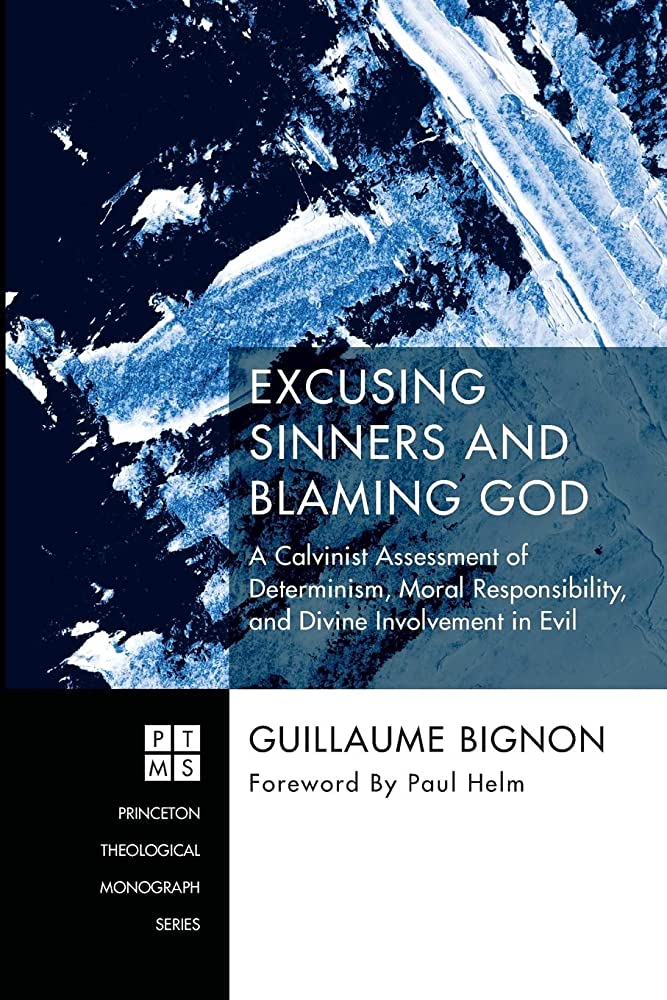
Guillaume Bignon’s 2018 book Excusing Sinners and Blaming God, a discussion of moral responsibility from the Calvinist point of view, came out just after I had decided to give up my PhD studies on the same general topic from the same perspective. I read it with hope and interest, especially since the book was favorably reviewed by an impressive line-up of Christian philosophers and theologians. However, while acknowledging its value in many respects, I eventually concluded that the book fell short of actually moving the conversation forward. I posted an initial review on Amazon, then took it down after I felt it came across as a bit too negative. After Kevin Timpe published his rather biting review of the book, however, I felt obliged once again to briefly put down some of my own comments. Alas, due to preoccupation with other matters, I am just now getting to that task.
I will attempt to be as succinct as possible. Bignon’s book, essentially his PhD thesis (in analytic philosophy of religion), is excellent in many respects. He displays a solid grasp of the general issues and discusses them lucidly. He makes some valid points and has some original and insightful observations, despite an odd tone at times that can only be described as “triumphant.” On occasion I agreed with his take on things–for example, about the significance of “flickers of freedom”–at other times, not so much. (Most significantly, perhaps, I feel as if the powerful intuitions expressed by the Consequence Argument were passed over far too quickly; as Aku Visala puts it in his review of Bignon’s book in The Journal of Analytic Theology, since these intuitions are widely shared and fairly compelling, surely some explanation of compatibilist accounts of control are warranted; more on this in a moment.) Perhaps more importantly than anything else, however, the book is (in my view, at least) faithful to Scripture, and for that we can be genuinely thankful. All told, it is a solid overview of (mostly) philosophical objections to Calvinist models of responsibility, and, again, offers plenty that is worth thinking about.
Still, the book has some sections that are not so effective. As Timpe notes, much of Bignon’s discussion, especially (though not exclusively) in the early chapters, is either trivial or passé (I was rather humorously reminded at times of the childhood trick of spreading food around on one’s plate to give the appearance of having eaten). One wonders how such material made it through the many well-qualified readers (though I note that our current flock of Calvinistic philosophers has very few representatives in the field of philosophy of action, which is what much of the book is about). The book’s main failure, however, is that it does not offer up anything new regarding the conditions for moral responsibility, as I mentioned above, and as Timpe and Visala both note. Everyone in the field is familiar with the classic “conditional analysis,” in which compatibilists assert that people could do otherwise if they wanted to, thereby granting them some notion of ability. Bignon comes back to this again and again, but sticking with this line of thinking seems outdated at best. As the discussion generally goes, the problem with compatibilism is that if our desires themselves are determined–and therefore not (potentially) under our control–then surely some further account of how we exercise meaningful control must be given, in order to establish moral responsibility. Several compatibilist philosophers, such as Harry Frankfurt and Lynn Rudder Baker, have attempted this in recent years, and in my mind the field is awaiting further efforts. But on this point Bignon offers nothing, and he even admits that he has nothing new to give.
At the critical moment in Chapter Six, Bignon offers an argument from the nature of God, who of necessity does all things righteously; surely this is evidence against the need of a freedom that depends on alternative possibilities. But as Bignon himself admits, using an argument from the nature of God is fraught with difficulty; for one, God is clearly not like us. One feels that such arguments, while not uncommon in the literature, are to some extent an evasion. Again, where humans are concerned, we must indeed labor to set forth the relevant conditions that show how we might be held responsible on compatibilism. It is a challenge that deserves to be met. In short, we need a serious, robust attempt at the whole picture of human decision-making, and a renewed effort to try and trace out the necessary and sufficient conditions whereby we can say someone is responsible. I do not feel that any philosophical attempt to defend Calvinism can be complete without such an undertaking. But in my opinion this will take a great deal of imagination and a hearty dose of courage, not to mention some concrete (and possibly scientific) thinking; and, to be frank, not many in the field of analytic philosophy–which is mostly concerned with abstract minutiae–possess such larger attributes or interests.
Again, Bignon’s book clearly has value. He covers a good deal of material and makes some poignant observations. But in my view, if someone is really going to push this conversation forward, they need to get more serious about the difficult work of attempting to set forth new compatibilist models of moral responsibility and lay out all the necessary and sufficient conditions. There may not, indeed, be a “smoking gun” where compatibilism is concerned, and I suspect that God’s view of responsibility, in the end, will come out a bit different than anything we have conceived. But surely we can do better than simply referring to the conditional analysis. There are other important conditions lurking, even in Scripture; there are vital links in the chain of human decision making that are begging to be explored, such as knowledge, memory, conscience, and power (not over the past, but over the future), all of which factor in to the notion of control. This is no longer my field; urgent spiritual matters once again take up the lion’s share of my time. But if there is any place at all for such philosophical inquiry, then hopefully someone else will come along and dig a little deeper into the unexplored issues, being faithful to Scripture, as Bignon so wonderfully is, along the way.
